
How MENA can lead on CORSIA: collaboration before compliance
Early, coordinated action matters for airlines, regulators and markets
by Simon Talling-Smith, Partner, SkiesFifty
At SkiesFifty, we often say that sustainable aviation will not be delivered by any single technology, policy instrument or actor acting alone. Achieving net zero will require unprecedented collaboration across the industry. Airlines, aircraft manufacturers, fuel producers, carbon market developers, financiers, regulators and governments each hold a piece of the jigsaw puzzle. None can solve it independently. Progress depends on alignment — between policy and capital, between innovation and scale, and between near-term action and long-term ambition.
In the Middle East, this collaborative mindset is already well established. The region has repeatedly demonstrated an ability to mobilise around complex, long-horizon challenges when there is clarity of direction and shared intent. That capability will become increasingly important as global aviation climate policy moves from design to delivery.
Against this backdrop, CORSIA provides a concrete lens through which we can clearly see that collaboration is no longer optional, but essential to managing both emissions and risk.
The CORSIA lens
CORSIA (the Carbon Offsetting and Reduction Scheme for International Aviation) is a global, market-based mechanism designed to cap and neutralise carbon dioxide emissions from international aviation. Developed by the International Civil Aviation Organisation (ICAO), CORSIA requires airlines to monitor and report emissions from international flights and to compensate for emissions growth above a defined baseline. This compensation can be achieved through the use of eligible sustainable aviation fuels or by retiring approved carbon credits.
Of course, CORSIA is no substitute for long-term decarbonisation through fleet renewal and large-scale SAF deployment. But it is now a structural part of the aviation decarbonisation landscape, and its importance will increase as enforcement tightens and baselines become binding.
For the Middle East, with its concentration of long-haul international traffic and hub-based networks, these dynamics mean CORSIA becomes financially and operationally material earlier than in many other regions.
MENA’s advantagous position
From a regulatory and policy perspective, several players in the MENA region are already well positioned. Multiple GCC states have volunteered to participate in CORSIA Phase 1 from 2026, and regulators have been actively building the institutional frameworks needed for implementation. Saudi Arabia, Qatar and the UAE, in particular, have moved beyond high-level commitments and into practical readiness — establishing emissions monitoring regimes, issuing guidance to operators and embedding CORSIA into national aviation oversight.
As CORSIA coverage expands through participating state pairs and into Phase 2, the aviation model in much of the Middle East amplifies exposure. Gulf carriers operate some of the world’s largest international networks, with a high proportion of long-haul, cross-border traffic. That concentration translates directly into material offsetting obligations.
At the same time, the global supply of fully CORSIA-eligible carbon credits remains limited. Only a narrow pool of projects currently meets the full Phase 1 requirements, including updated methodologies, host-country approvals, corresponding adjustments and delivery risk protections. Many project developers are still upgrading assets and are hesitant to invest without clearer, longer-term demand signals. For airlines with significant international exposure, this combination of high demand and constrained supply creates a real risk profile.
Why time is of the essence
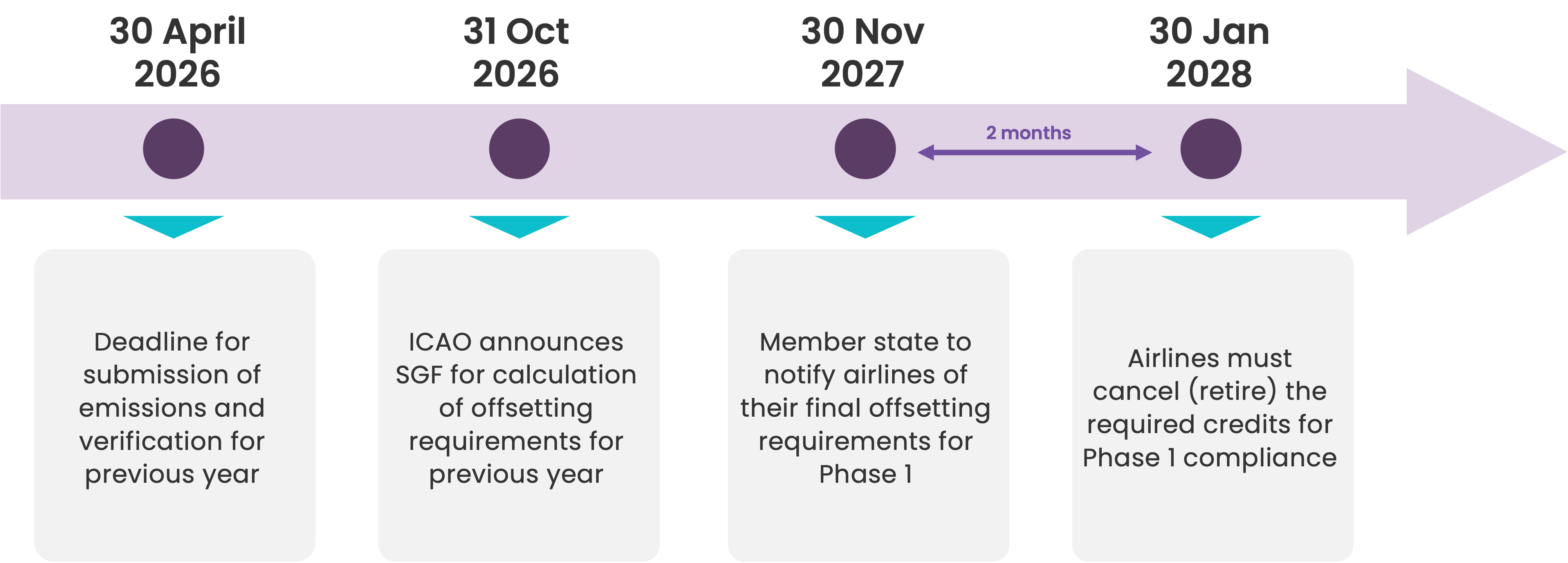
The compliance timeline is tight. Airlines will receive their final Phase 1 offsetting obligations inNovember 2027 and must retire the required credits just two months later, by 31 January 2028. Relying on spot market purchases in such a narrow window exposes airlines to price volatility and, in a worst-case scenario, insufficient supply.
For airline finance teams,CORSIA is no longer a future sustainability consideration, but a near-term exposure that cuts across procurement, risk management and compliance. The risk is that a large number of airlines will be forced through a narrow compliance window at the same time, competing for a limited pool of fully eligible credits. With penalties in major markets now set around €100 per tonne, CORSIA is no longer a marginal sustainability issue. It is a balance-sheet consideration.
Collaboration is key
This is where a different approach becomes necessary. A CORSIA Coalition, structured around an Advanced Market Commitment (AMC) model, offers a way to turn fragmented future demand into a credible, investable signal for suppliers. By aggregating demand across airlines, such a coalition can secure multi-year off take agreements, support project developers in completing CORSIA-compliant upgrades, and encourage host countries to issue the approvals needed to unlock supply.
For airlines, the benefits are clear: reduced price risk, improved supply security, and avoidance of alate-cycle scramble for limited volumes. For the market as a whole, this approach promotes stability, transparency and scalability.
At SkiesFifty, we see our role as that of a convenor and catalyst — encouraging collaboration across airlines, suppliers, regulators and investors where collective action is needed to drive progress. We are already in active conversations with multiple airlines across the region about how such a coalition could be structured in practice — aligned with regulatory requirements, commercially disciplined, and flexible enough to evolve as CORSIA moves fully into Phase 2.
The Middle East has the opportunity not just to comply with CORSIA, but to help shape how the market functions — moving from reactive buying to coordinated action that supports both climate goals and financial resilience.
In conclusion
CORSIA should not be viewed as a distraction from long-term decarbonisation, nor as a box-ticking exercise. It is a bridge, imperfect but necessary, between today’s realities and tomorrow’s solutions.
For airlines, regulators and market participants across the region, this is a moment to engage early, share perspectives and shape practical solutions together. The question is not whether CORSIA will matter, but whether they will approach it individually and reactively, or collaboratively and strategically.
At SkiesFifty, we welcome those conversations and the opportunity to work collaboratively to help the market evolve in a way that is credible, resilient and effective. The window to choose is open now, but it will not remain so for long.
--
This article is being published simultaneously by SkiesFifty and Sustainable Aviation Futures. You can read the article on the Sustainable Aviation Futures website here.